
Introducción
If you own a holiday rental in Spain, the administrative landscape has just shifted. A new mandatory annual reporting requirement has been enacted, and missing the deadline could jeopardize your ability to legally operate your property.
On December 31, 2025, the Spanish Ministry of Housing published Order VAU/1560/2025—a regulation that establishes a critical new compliance obligation for all property owners listed in the Single Registry of Rentals. This is not optional. It is not a suggestion. It is a legal requirement with immediate consequences for non-compliance.
At Lextax, we act as your «Translator of Complexity.» Our role is to decode regulations that confuse and frustrate, and convert them into actionable guidance. In this article, we explain exactly what this new obligation is, who it affects, the critical deadlines you cannot miss, and—most importantly—the steps you must take now to protect your investment.
SECTION 1: CONTEXT – THE EVOLUTION OF SPAIN’S RENTAL CONTROL SYSTEM
1.1 The Single Registry: Foundation for Digital Control
To understand the new Annual Reporting Obligation, we must first understand the Single Registry of Rentals (Registro Único de Arrendamientos).
Spain’s government created this centralized system to achieve a single objective: eliminate illegal, unregulated short-term rentals. The system assigns each registered property a unique identifier (NRUA—Número de Registro Único de Arrendamientos), which must be displayed on all booking platforms.
Think of it as the backbone. The Annual Information Model is the control mechanism that keeps that backbone functioning.
Key Facts About the Single Registry:
- Implemented via Real Decreto 1312/2024 (December 23, 2024).
- Properties are registered through the Land Registry (Registro de la Propiedad) or the Chattel Registry (Registro de Bienes Muebles).
- Digital data flows to a centralized Digital Single Window (Ventanilla Única Digital) managed by the Ministry of Housing.
- The system is linked to EU Regulation 2024/1028, which harmonizes short-term rental data collection across all EU member states.
For a comprehensive explanation of the Single Registry, see our detailed guide: Single Tourism Registry in Spain: Complete Guide
1.2 Why the Government Wants Data
The answer is simple: transparency and tax enforcement.
Spain’s housing crisis and affordable housing shortage have created political pressure to regulate vacation rentals. But the government also has a fiscal motive: to ensure that rental income is properly declared and taxed.
By collecting annual data on rental activity, authorities can:
- Cross-reference your registry declarations with your tax filings.
- Identify properties registered for tourist use but actually occupied as permanent residences.
- Detect unreported income.
- Ensure compliance with local zoning and municipal regulations.
This is why the Annual Information Model is so dangerous if filed incorrectly: it is evidence used by both the Ministry of Housing (for regulatory enforcement) and the Tax Agency (for fiscal audits).
SECTION 2: WHAT EXACTLY IS THE NEW OBLIGATION?
2.1 The Annual Information Model: Definition and Scope
What it is:
The «Modelo Informativo de Arrendamientos de Corta Duración» (Information Model for Short-Term Rentals) is an annual sworn statement and data submission that confirms:
- The actual usage of your registered property during the prior calendar year.
- The cause or purpose of each rental contract (e.g., tourist, seasonal, medical, educational).
- Proof that the property was NOT used as a permanent residence (vivienda habitual) under the Spanish Urban Leases Act (Ley 29/1994).
What it covers:
The report must include:
- An anonymized list of all rental contracts concluded during the year.
- The category of each rental (choosing from 5 standardized options).
- The number of guests per contract.
- Entry and exit dates for each rental.
- Any periods during which the property had no rental activity.
Format and submission:
- Available in paper or electronic format.
- Electronic submissions use XBRL taxonomy (an international standard for financial and non-financial data).
- Submitted through the E-sede of the Colegio de Registradores (Registry Professionals Association).
2.2 The Five Rental Categories
When you file your Annual Report, you must classify each rental contract under ONE of these five categories:
| Category | Definition | Examples |
| 1. Vacational or Tourist (Vacacional o Turístico) | Temporary stay for leisure or tourism | Holiday homes, seasonal beach properties, ski lodge rentals |
| 2. Occupational (Laboral) | Temporary accommodation for work | Housing for temporary employees, project workers, expat relocations |
| 3. Educational (Estudios) | Housing for students or trainees | University housing, language course accommodation |
| 4. Medical (Médico) | Temporary accommodation for medical treatment | Recovery stays, clinical trials, long-term medical procedures |
| 5. Other (Otros) | Any other temporary cause NOT related to permanent housing | Family visits, sabbaticals, temporary sabbaticals |
Critical Rule: The key distinction is that ALL of these categories must represent a temporary need—not a permanent change of residence. If a tenant is moving to Spain to live permanently, they need a standard residential lease under the LAU (Urban Leases Act), not a short-term rental registration.
2.3 The Documentation You Must Retain
To successfully file this report, you must have documentary evidence that each rental falls into the category you claim. If the Registrar has «well-founded doubts,» they can demand:
- Employment contracts (for occupational rentals).
- University enrollment letters (for educational rentals).
- Medical documentation (for medical rentals).
- Proof of temporary nature (for tourist or other rentals).
The Message: Do NOT delete emails, booking confirmations, or communications with tenants. These are your evidence that your registered use matches your actual use.

SECTION 3: CRITICAL DEADLINES – DO NOT MISS FEBRUARY 2026
3.1 Timeline
| Date | Event | Action Required |
| January 1 – December 31, 2025 | Reporting period for the first annual report | Monitor rental activity; retain all documentation |
| February 1 – February 28, 2026 | Filing window for 2025 rental data | Submit Annual Information Model to the Land Registry |
| March 1, 2026 onwards | Post-deadline period | Late filings incur penalties and raise red flags |
3.2 The Consequences of Missing the Deadline
The Spanish law is explicit about what happens if you do not file by February 28, 2026:
Immediate Consequence:
Your NRUA (registration number) will not be renewed for the 2026 tax year. This means digital platforms will be legally obligated to delist your property.
Cascading Effects:
- Loss of Rental License: Your ability to legally market and rent the property ceases.
- Revenue Loss: Bookings drop to zero; incoming reservations are canceled.
- Municipal Fines: Local authorities can issue administrative penalties for operating without current registration.
- Tax Audit Risk: Non-filing triggers an immediate investigation by tax authorities.
- Potential Back-Tax Assessments: Authorities may reassess your prior rental income based on platform data (Form 179 from Airbnb, Booking, etc.).
In short: This is not a bureaucratic formality. It is the mechanism by which the government enforces compliance.
SECTION 4: THE HIDDEN DANGER – THE TAX CONNECTION
4.1 Cross-Referencing: Registry vs. Tax Filings
The Annual Information Model is not filed in isolation. It becomes evidence in a larger compliance picture.
Here’s how it works:
Step 1: You file your Annual Information Model with the Land Registry (February 2026).
- You report, for example, that your property was rented for 150 days in 2025.
Step 2: The Ministry of Housing shares this data with the Tax Agency (Agencia Tributaria).
- The data flows to the centralized Digital Single Window, which is monitored by fiscal authorities.
Step 3: Your tax filings (Form 210 for non-residents; IRPF for residents) are cross-referenced.
- If your tax return reports only 100 days of rental income, but your registry report says 150 days, a mismatch flag is raised automatically.
Step 4: Audit and penalties ensue.
- The Tax Agency opens an investigation.
- Penalties range from 50% to 150% of unpaid tax, plus interest.
4.2 The Matching Obligation
To avoid this trap, you must ensure strict consistency between:
| Filing | Reported Information | Timeline |
| Annual Information Model | Days property was rented; categories of rental; number of guests | February 2026 (one-time, annual) |
| Quarterly Form 210 (Non-Residents) | Rental income by quarter; expense deductions | Due 4 times per year |
| Annual IRPF (Residents) | Total rental income; expense deductions; capital gains | Due April-June annually |
| Platform Reporting (Form 179) | Airbnb, Booking, etc. report guest-days directly to Tax Agency | Automatic; monthly/quarterly |
The takeaway: Your registry declarations, tax filings, and platform data must tell the same story.
4.3 Real-World Example: The Mismatch Scenario
Scenario:
- You own a 3-bedroom apartment in Barcelona registered as a «tourist rental.»
- You rented it 120 days in 2025.
- You filed your quarterly Form 210 correctly, reporting income for 120 days at €80/night = €9,600 gross.
- BUT, you deducted mortgage interest, repairs, and utilities totaling €4,000, leaving €5,600 taxable income at 19% IRNR = €1,064 tax owed.
- You paid this correctly.
Now comes February 2026:
- You file your Annual Information Model… but you only report 90 days of rental activity (you forgot or omitted some short rentals that weren’t on your primary platform).
The Red Flag:
- The Tax Agency notices that Airbnb/Booking reported 120 guest-days (Form 179), but your Annual Information Model reports only 90 days.
- The Registrar is alerted to a potential misrepresentation.
- Your property faces a compliance review.
Outcome:
- You may be charged with «incorrect use of registration.»
- Your NRUA could be withdrawn.
- A tax audit is opened to determine which figure is correct.
- If authorities determine you underreported, you owe back-taxes plus penalties.
This scenario is entirely preventable with proper documentation and professional assistance.
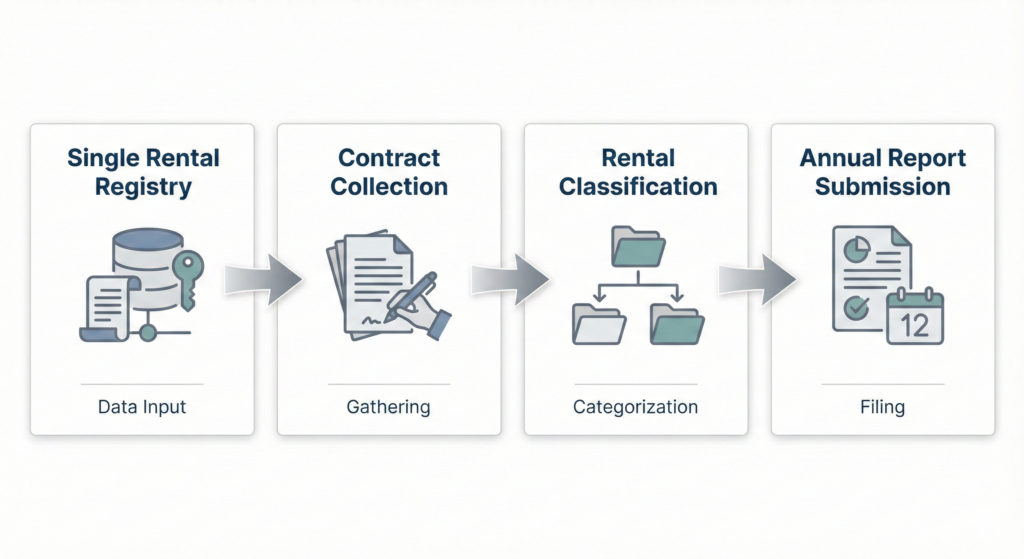
SECTION 5: HOW TO COMPLY – STEP-BY-STEP ACTION PLAN
5.1 Step 1: Audit Your Current Registration (January 2026)
Action:
Contact the Land Registry where your property is registered and confirm:
- Your property’s NRUA (registration number).
- The category under which it is registered (Tourist, Occupational, Educational, etc.).
- Whether your registration is active for 2025-2026.
Why it matters:
If your registration is already cancelled or expired, this is your first problem to solve before filing the new Annual Report.
5.2 Step 2: Compile Your Rental Records (January 2026)
Documentation to gather:
- Complete list of all rental contracts concluded in 2025.
- Guest names and check-in/check-out dates.
- Platform records from Airbnb, Booking, Vrbo, or direct bookings.
- Guest communications proving the purpose of the stay (tourist, worker, student, etc.).
- Any agreements or contracts with guests.
Pro Tip: If you use a property management company, request they provide a summary report of all 2025 rentals by category.
5.3 Step 3: Classify Each Rental (Late January 2026)
Task:
Go through your list and assign each rental to ONE of the five categories. This is not trivial.
Examples of proper classification:
| Rental | Category | Evidence |
| British couple, 2-week summer vacation | Vacational/Tourist | Booking.com listing; guest profile; no permanent intention |
| German engineer, 3-month assignment with local company | Occupational/Laboral | Employment contract; company letter; temporary assignment duration |
| Spanish student from Madrid, 9-month stay during university year | Educational/Estudios | University enrollment; student ID; housing address change documents |
| French widow, 6-week recovery stay after surgery | Medical/Médico | Doctor’s letter; hospital discharge papers; temporary stay documentation |
5.4 Step 4: Cross-Check Your Tax Filings (Late January 2026)
Action:
Ensure your 2025 tax filings (Form 210 or IRPF, depending on residency) match your planned Annual Information Model report.
- Days reported in registry: 150 days.
- Income days in Form 210: Must also be 150 days (or clearly documented reason for discrepancy).
If there is a mismatch, you have two options:
- Amend your tax filing (if within the correction period—usually 4 years).
- Explain the discrepancy in writing before filing the Annual Information Model.
For detailed guidance on tax obligations, see: Tax Obligations When Renting Your Property to Tourists in Spain
5.5 Step 5: File the Annual Information Model (February 2026)
Method 1: Electronic Filing (Recommended)
- Access the E-sede of the Colegio de Registradores: https://www.registradores.org
- Submit in XBRL format using the official taxonomy (available on the Registradores website).
- Receive electronic confirmation of receipt.
Method 2: Paper Filing
- Obtain the official form from your local Land Registry.
- Print, complete by hand, and submit in person or by post.
- Less secure; proof of delivery is harder to establish.
Recommendation: Use electronic filing. It creates a verified audit trail and reduces errors.
SECTION 6: FREQUENTLY ASKED QUESTIONS
I have a tourist license from my local municipality, but I didn’t rent my property in 2025. Do I still need to file the Annual Information Model?
Yes, you must file. If your property had zero rental activity, you will likely need to report «no activity» or submit a «negative report.» Failing to file could be interpreted as abandoning your registration, leading to automatic cancellation.
Can I file this report myself, or do I need a lawyer?
Technically, you can file it yourself. However, the report uses a technical format (XBRL taxonomy) and serves as evidence in potential regulatory or tax disputes. Lextax strongly recommends professional assistance because:
- Errors in data entry lead to registration cancellation.
- Misclassification of rentals can trigger audits.
- Professional filing creates a defensible record.
How does this Annual Information Model connect to my tax obligations?
They are separate but linked. Tax obligations (IRPF or Form 210) are about declaring income. The Annual Information Model is about proving the legal status of your property. Both must align. If they don’t, you face penalties from BOTH the Ministry of Housing (loss of registration) and the Tax Agency (back-taxes and fines).
I own multiple properties. Do I file one report or one per property?
One report per property. The regulation specifies «un modelo informativo por finca» (one model per property). If you own three tourist rentals, you will submit three separate Annual Information Models in February 2026.
What happens if I file late?
A: Late filing results in:
- Automatic non-renewal of your NRUA.
- Delisting from digital platforms (mandatory).
- Administrative fines.
- Potential tax audit.
There is no grace period. The deadline is February 28, 2026.
Can I amend my report after February 28, 2026 if I find errors?
The regulation does not explicitly address amendments. In practice, you should attempt to correct errors immediately upon discovery, but late corrections may not restore your NRUA if it has already been cancelled. This is another reason to file correctly the first time, with professional assistance.
I am a non-resident owner living in the UK/USA. Do I need to file this report personally, or can my Spanish property manager do it?
The property owner is legally responsible for the filing. However, a fiscal representative or property manager can file on your behalf with a power of attorney (poder). Lextax can assist with this process.
What if my property was rented for part of the year and occupied by family for the other part? How do I classify that?
You report only the rental contracts. Days when you or family members occupied the property are not reported as «rentals.» However, if you are claiming residential exemptions (e.g., claiming the property as your main home for tax purposes), this may disqualify it from short-term rental registration altogether. This is a complex situation that requires legal review.
If my platform (Airbnb) already reports my rental data to the Spanish government, why do I need to file this Annual Information Model?
Platforms like Airbnb report transaction data (Form 179) to the Tax Agency, which is about tax compliance. The Annual Information Model is filed with the Land Registry and is about property registration compliance. They serve different authorities and different purposes. Both are mandatory.
Can I lose my property if I don’t file this report?
No, you cannot lose ownership of the property itself. However, you will lose your right to legally market and rent it as a short-term rental. Platforms will delist it, and operating it without current registration exposes you to municipal fines.
SECTION 7: WHY PROFESSIONAL ASSISTANCE MATTERS
7.1 The Complexity Tax
Many property owners attempt to file regulatory documents themselves to save costs. However, the risk-to-savings ratio in this case is heavily skewed.
If you file incorrectly:
- Cost of error: Loss of ability to rent your property + potential audit + back-taxes + fines (50-150% of unpaid tax).
- Estimated financial impact: €5,000 – €50,000+ depending on prior rental income.
If you hire Lextax:
- Professional fee: €1,500 – €3,500 depending on property complexity.
- Cost of prevention: One-time; saves you from a cascade of penalties.
The ROI is immediate and substantial.
7.2 The Lextax Process
When you engage Lextax for your Annual Information Model compliance:
- Registry Audit: We confirm your property’s current NRUA status and registration category.
- Documentation Review: You provide rental records; we verify completeness and accuracy.
- Classification: We assign each rental to the correct category based on evidence.
- Tax Cross-Check: We ensure your Annual Information Model aligns with your tax filings (Form 210 or IRPF).
- Filing Preparation: We prepare the formal XBRL submission and handle electronic filing.
- Confirmation: We retain proof of filing and advise on next steps.
Result: A compliant, defensible record that protects your property license and tax status.
CONCLUSION: ACT NOW
The Bottom Line:
The Annual Information Model is not a distant worry. It is due in February 2026—just weeks away. If you own a short-term rental property in Spain and have not yet prepared, now is the time to act.
Your Checklist:
- Confirm your property’s NRUA with your Land Registry.
- Compile a complete list of all 2025 rental contracts.
- Classify each rental by category (Tourist, Occupational, Educational, Medical, Other).
- Ensure your tax filings match your rental data.
- Contact Lextax to handle professional filing.
The Stakes:
- Miss the deadline: Lose your registration license and face audit risk.
- File incorrectly: Trigger regulatory scrutiny and potential back-tax assessments.
- File correctly with professional assistance: Protect your asset and income stream for 2026 and beyond.
RELATED ARTICLES
Single Tourism Registry in Spain: Complete Guide
Tax Obligations When Renting Your Property to Tourists in Spain